Molecular Engineering & Cloning
From bespoke gene design through high-throughput vector construction to endotoxin-free plasmid prep, the molecular foundation that determines whether your protein expresses, folds, and yields.
Project Design & Gene Engineering
Every project begins with a co-designed strategy. We work with users to select the right host, vector backbone, fusion partners, signal peptides, and purification tags for the intended downstream application, whether that is structural biology, functional assay, animal study, or biotherapeutic candidate progression.
Codon optimisation, signal peptide engineering, domain truncation, mutagenesis, and synthetic gene assembly are routine. Multi-domain constructs, fusion proteins, antibody formats (scFv, Fab, IgG, bispecifics), and complex multi-subunit assemblies are all supported.
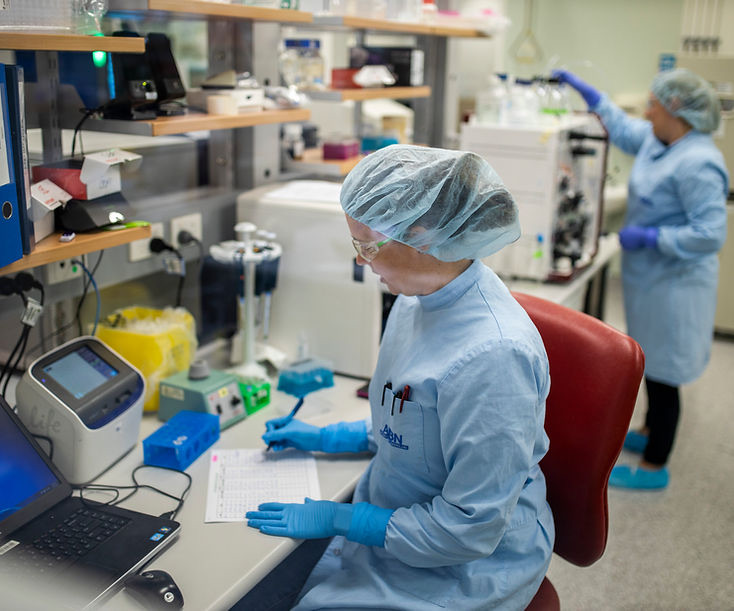
Endotoxin-Free Plasmid Production
For projects destined for cell-based assays, transfection of mammalian cells, in vivo studies, or downstream therapeutic development, NBF produces endotoxin-free plasmid preparations to research and pre-clinical grade.
Yields are scaled to project need, from microgram screening preps through to milligram-scale production of precursor plasmids for transient transfection campaigns and stable cell line generation.
Vector Suite
A comprehensive backbone library covering every supported host, with a curated tag panel for solubility, affinity capture, fluorescent tracking and protease cleavage.
| Host | Vector Backbones & Tag Options |
|---|---|
| E. coli |
pOPIN-NHis
pOPIN-NHis3C
pOPIN-TRX
pOPIN-SUMO
pOPIN-GST
pOPIN-NusA
pET series
pGEX series
pDEST series
|
| Yeast |
pPink-αHC
pPICZα-A/B/C
pPICZ-A/B/C
pHIL-S1
|
| Insect (BEVS) |
pFastBac-1
pFastBac Dual
pBac-1 (flashBAC)
pVL1392 / pVL1393 (BaculoGOLD)
pENTR (BaculoDirect)
|
| Mammalian |
pcDNA3.1
pcDNA3.3
pOPIN mammalian
|
| Fluorescent |
EGFP fusions
ECFP
EBFP
Citrine
mCherry
|